Wednesday, 18 April 2012
Google’s Robot Cars
1. Google's Robot Cars
Testifying before the Nevada State Assembly in April to have the state legalize its driverless cars, Google lobbyist David Goldwater asked the state’s transportation committee to “imagine a time when we will be able to call our public transportation on our cell phones or smartphones and tell it to come to our door to pick us up, without anybody in it, take us to our job, and be released to go perform the same service for somebody else.”
But a world filled with robot cars may have consequence even their
creator can’t predict. Driverless cars would be a perfect match for
car-sharing services such as Zipcar or Getaround, gradually replacing
the idea of car ownership with “mobility-as-a-service.” That, in turn,
may lead to a precipitous fall in car ownership--as high as 50%--while breathing new
life into suburbia and creating more congestions as the pain of commuting lessens. And what would halving the
number of cars on the road mean for the Detroit Three--and the taxpayers
who’d like the rest of their bailout back?
Six months before that hearing, when they were first reported in The New York Times, Google’s test cars had traveled 140,000 miles with only one accident. (A car was rear-ended while stopped at a light.) Since then, its car czar Sebastian Thrun--a former Stanford AI professor who won DARPA’s autonomous vehicle competition in 2005--has been vocal about the possibilities of cars without drivers, including fuel efficiency and fewer fatalities. And, perhaps most importantly, a future without horrible commutes.
2. The Commute of the Future
At last month’s Maker Faire 2011 in San Mateo, California, Thrun regaled the crowd
with visions of a “car-train” composed of robot cars traveling on
highways in close proximity to each other, using the “drafting”
technique typical of NASCAR drivers to speed up while saving fuel by as
much as 25 percent. “Think about the car as a medium of mass transit,”
he said, because you wouldn’t have to think about where you were going
or how you were getting there.
“The typical American spends an average of roughly 100 hours a year in traffic,” the economist Tyler Cowen wrote a few weeks ago in support of driverless cars. “Imagine using that time in better ways--by working or just having fun.”
One thing is certain--our current commutes need changing. They are making us fatter, unhappier, lonelier, and are probably killing us.
Last month, researchers at Sweden’s Umea University published their
finding that couples in which one partner commutes for longer than 45
minutes are 40% likelier to divorce.
But what if driverless cars mimicked transit instead? What
if you could watch movies, make Skype calls, or play with your children
in the back seat until you were delivered to your doorstep? A
game-changer in terms of commuting time and cost, it would breathe new life
back into suburban sprawl; it's not a problem to live two hours from
work when you can spend those two hours as if you were on your couch.
And what if you didn't even have to be making payments on that car that was driving you to work. Robot cars could allow us to drastically reduce car ownership.
3. "Zipcar, come here."
“What if I could take out my phone and say, ‘Zipcar, come here,’” Thrun asked rhetorically at a conference last year, “and a moment later the Zipcar came around the corner?” It’s not a stretch to imagine robot cars as a boon for car-sharing services.
But better positioned are new peer-to-peer services such as Getaround, which launched two weeks ago with 1,600 cars already enrolled--equivalent to 20% of Zipcar’s fleet. Membership is free, insurance and 24-hour roadside assistance is included, and all that’s required of car owners is installing a keyless remote to allow other Getaround users to unlock the car.
In a driverless world, owners would barely bad credit loans notice when their car was missing. They would just call another while their formerly sunk cost was out earning money. It would beat letting it collect dust in the garage every day, which is what most of us do now.
“There are over 250 million personal vehicles in the U.S. and they sit idle an average of 22 hours each day,” according to Getaround cofounder Sam Zaid. What would happen if, thanks to Getaround and Google, they only sat idle for, say, 20 hours a day? How many fewer cars would we need?
4. As Goes GM, So Goes The Nation
If Thrun and Sam Zaid of Getaround are correct, it could be possible to dramatically increase the utilization of cars (and congestion) while shrinking their numbers unsecured loans overall. (Highways would be as crowded as ever, but there would be a lot more open parking spots.) And then what would that mean for the (formerly) Big Three?
For the answer to that, we need look no further than 2009, the U.S. auto industry’s annus horriblis in which the total number of cars on the road contracted for the first time since World War II. Not coincidentally, both GM and Chrysler filed for bankruptcy that year.
More troubling than the one-time dip of the financial crisis is the gradual erosion in the number of teenage drivers, whose numbers have fallen below 10 million (from a peak of 12 million in 1978), despite the largest teenage population ever. “Many of today’s young people living in a more urban society learn to live without cars,” theorized the environmentalist Lester R. Brown at the time. “They socialize on the Internet and on smartphones, not in cars.”
Perhaps in the future, they will socialize on smartphones in driverless cars. In that case, to survive, the auto industry's business model might be starting to look like the smartphone one--with the hardware made in China, and the brains supplied by Google.

Bt infinity increase there speed
The boost will come at no extra charge, though existing customers will need to sign up to new contracts, the company said on Wednesday. The move fulfills a promise BT made in May, when the operator said it would roughly double the download speeds and increase the upload rates provided by its fibre-to-the-cabinet (FTTC) Infinity broadband services.
Customers on BT's up-to-38Mbps Infinity package — 'Option 2' — will get downloads of up to 76Mbps and see upload rates rise from 9.5Mbps to around 19Mbps, the company said. The upstream speed of Infinity 'Option 1' goes to a headline speed of 9.5Mbps, from its current 1.9Mbps. Downloads on Option 1 remain at up to 38Mbps.
"Delivery of the new increased speeds by BT Retail will help to achieve the government's stated ambition for the UK to have the best super-fast broadband network in Europe by 2015," BT said in a statement. "The high upstream speeds will also be of great benefit to customers who wish to upload photos, video, graphics or other rich content."
They will also contribute towards the government's ambition of delivering the best high-speed broadband network in Europe, BT added.
Super-fast rivalry
The rollout should increase BT's competitiveness with its key UK rival in super-fast broadband, Virgin Media, which already offers 100Mbps services. Like BT's Infinity, these are FTTC-based, but in Virgin's case, the final connection from the cabinet to the premises is done over co-axial cable rather than copper cable.
Virgin got a headstart on BT in 2008, when it launched a 50Mbps cable broadband service. At the moment, it is carrying out a speed upgrade programme unsecured loans that will see the headline speeds of its packages increase to up to 120Mbps.
Previously, BT promoted the Infinity packages it is upgrading as delivering speeds of up to 40Mbps, but changed its terminology after new industry advertising guidelines came in on 1 April.
New customers, and those on non-Infinity contracts, can sign up for the faster services from Thursday at no extra cost, BT said. Existing Infinity customers can upgrade their connections to get the faster speeds, also at no extra cost, but will need to start a new bad credit loans contract, renewable under the terms of the existing contract. For example, if an Infinity customer on a 12-month contract wants to upgrade, they must start a new 12-month contract; the same is true for customers on 18-month contracts.
BT said that Infinity is already available to seven million people across the UK and that the service will reach another three million premises before the end of the year.
Tuesday, 27 March 2012
GlaxoSmithKline
GlaxoSmithKline and Johnson & Johnson are forming a $200 million fund with Index Ventures to invest in early-stage biotechnology companies, a move that may entice venture capitalists back to the industry.
Glaxo and New Brunswick, New Jersey-based J&J will each put in $50 million, while Index Ventures will contribute $100 million and make investment decisions.
Moncef Slaoui, head of research and development at London-based Glaxo, and Paul Stoffels, J&J’s chairman of pharmaceuticals, will sit on the fund’s advisory board.
Early-stage companies have been struggling for financing as venture-capital firms turn instead to more mature businesses or less risky industries. unsecured loans
The new fund will stick to Index Ventures’ strategy of investing in early-stage, single-asset companies in Europe, the U.S. and Israel, a model the firm said has generated typical venture-capital returns in half the time.
“By investing in this fund, they are really super-powering or turbo-charging the asset-centric investment model,” said Francesco De Rubertis, the Index Ventures partner who bad credit loans is leading the fund, in an interview in London. “They are validating it as a potential new model for early-stage R&D funding.”
Wednesday, 21 March 2012
500GB portable external hard
This 500GB portable external hard drive is a reliable, easy-to-use hard disk to further add storage into a Macintosh or any personal computers. Users will just connect this portable external hard drive to a USB port and can begin backing up or saving important documents, files, video, music and photos. This external hard drive is preformatted for direct use, hence, it comes without a compact disc (CD) or software to download. The durable, compact metal case offers additional data protection that helps in keeping important files and documents from loss.
This Western Digital: My Passport Essential 500GB Midnight Black Portable Hard Drive (USB 3.0/2.0) is appropriate for people who do not want to disassemble their personal computers just to put in more storage space. This Western Digital: My Passport Essential 500GB Midnight unsecured loans Black Portable Hard Drive (USB 3.0/2.0) is very proficient, looks exceptionally stacked and is almost quiet when operated. This 500GB portable external hard drive is a rather huge-sized item that seems robustly made. It has no software to install for users will just connect it directly to the personal computer. With a 500GB capacity, this Western Digital: My Passport Essential 500GB Midnight Black Portable Hard Drive (USB 3.0/2.0) provides enough storage, admirably coping even with huge photographic photographs and several videos.
This Western Digital: My Passport Essential 500GB bad credit loans Midnight Black Portable Hard Drive (USB 3.0/2.0) is an external hard drive with 500GB capacity. In contrast to other available external hard disks, this Western Digital: My Passport Essential 500GB Midnight Black Portable Hard Drive (USB 3.0/2.0) is very inexpensive. Its 500GB capacity is significantly bigger than any the same priced external hard disks.
Monday, 19 March 2012
Badass Screen Dimmer
Is your Kindle screen too bright
for reading at night? Even on it's lowest Brightness setting, many
people find that the Kindle can be too bright for reading in a dark
room. Badass Battery Dimmer lets you dim the screen way past what the
built-in Kindle brightness setting will allow, giving you a much better
night reading experience. You can dim your screen without ever leaving
the app you are currently running. Better yet, you can see the content
on your screen while you dim - no need to launch into separate screens.
Main Screen:
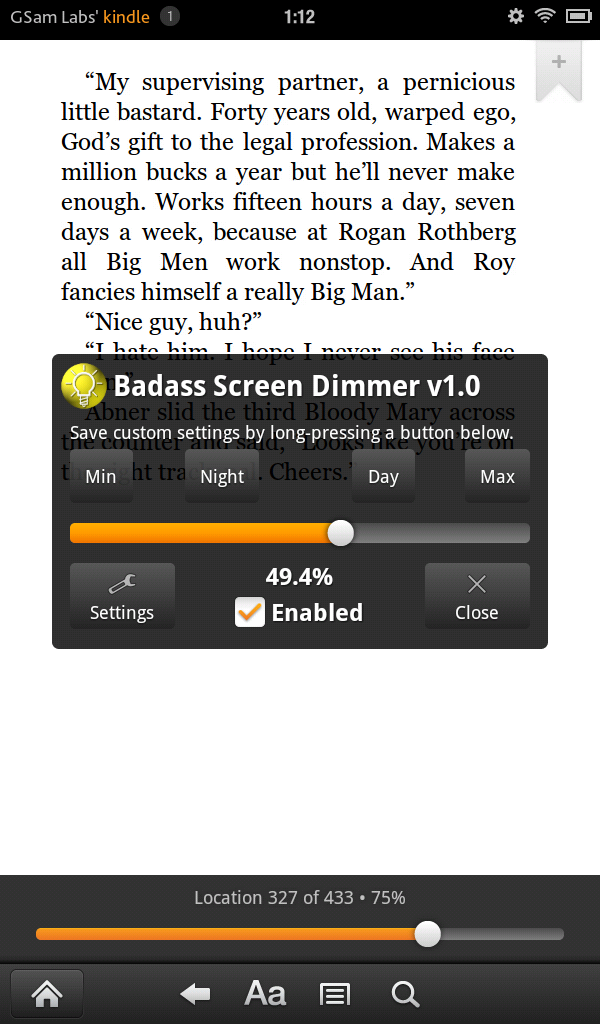
Badass Screen Dimmer has one screen. This can be launched from the Notification Bar (if enabled), or directly from your launcher tray. Note: Since this is a utility app you'll use often, it will not always show up on your Kindle Carousel. This is to prevent this app from always showing up in the first few Carousel items.
In order to work and dim the screen past what the Kindle usually allows,
the screen dimmer needs to always be running in the background. If you
want to change the brightness, simply launch the screen dimmer from the
notification bar, choose a preset button (or customize it with the
slider). Then close the screen, and continue reading.
Enabled: By default, the screen dimmer is not enabled. When it is not enabled, the standard Brightness settings for the Kindle will be used. When enabled, Badass Screen Dimmer will take over your brightness controls. Note: If you change the system brightness settings while the dimmer is enabled, the system settings will rule until you adjust (or disable/enable) the screen dimmer.
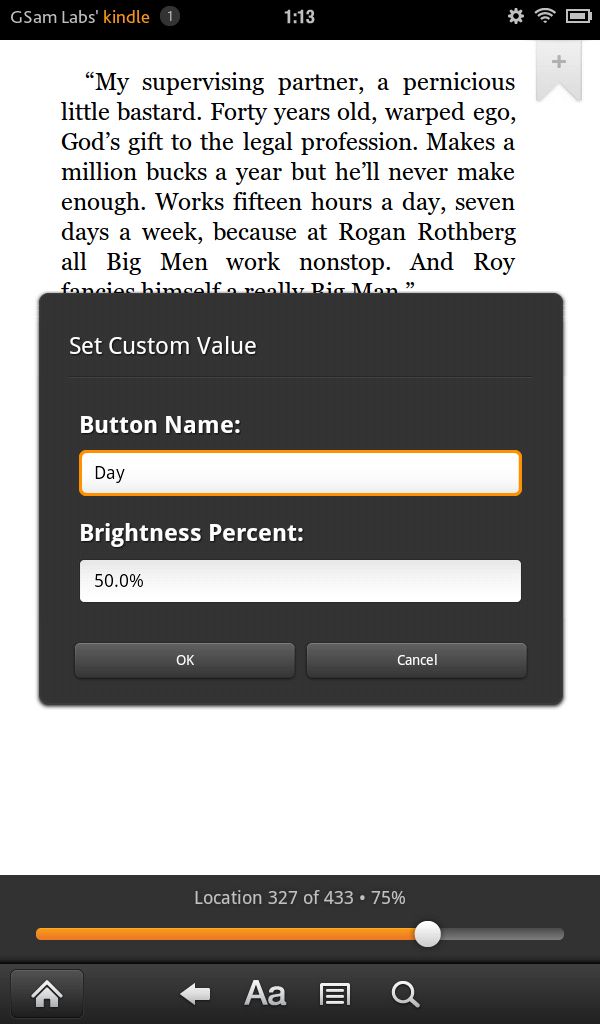
Preset Buttons: By default, Badass Screen Dimmer comes with 4
preset buttons (Min, Night, Day, and Max). Simply clicking on the
button will immediately adjust the display to the preset brightness.
Long-clicking the button will allow you to change the name (5 characters
only) and brightness setting for the preset. From hereon-out, clicking
the button will set the screen to your custom value.
Settings: By default, Badass Screen Dimmer will run on startup and show an icon in the Notification Bar. This provides very quick access to the utility without having to hunt through your app icons. You can disable either feature, but accessing the app becomes harder - and you want easy access to your Dimmer settings.
Troubleshooting:
 |
| Badass Screen Dimmer |
Badass Screen Dimmer has one screen. This can be launched from the Notification Bar (if enabled), or directly from your launcher tray. Note: Since this is a utility app you'll use often, it will not always show up on your Kindle Carousel. This is to prevent this app from always showing up in the first few Carousel items.
 |
| Launching Badass Screen Dimmer |
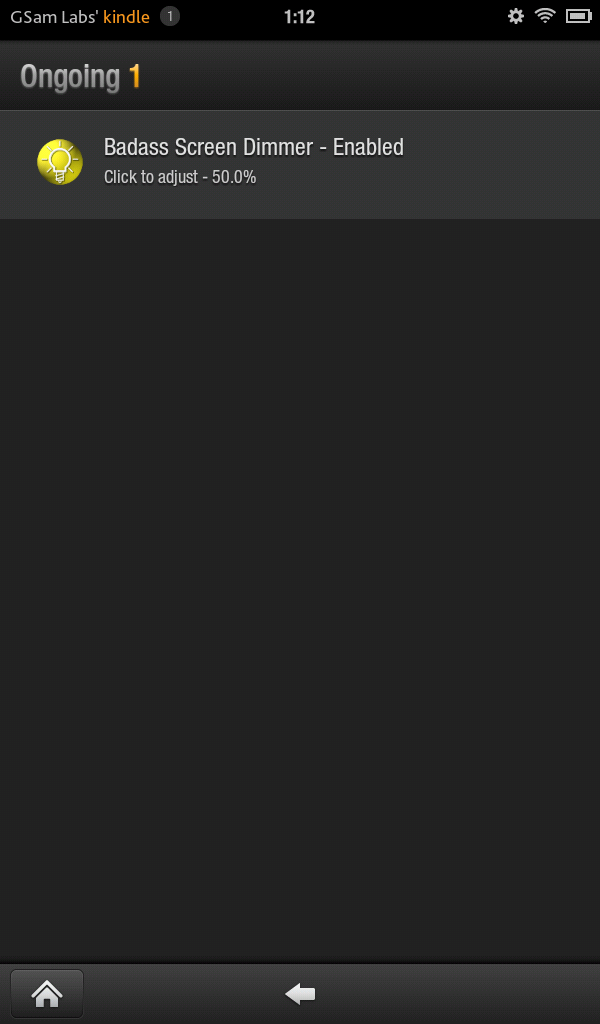
Enabled: By default, the screen dimmer is not enabled. When it is not enabled, the standard Brightness settings for the Kindle will be used. When enabled, Badass Screen Dimmer will take over your brightness controls. Note: If you change the system brightness settings while the dimmer is enabled, the system settings will rule until you adjust (or disable/enable) the screen dimmer.
 |
| Customize Preset Buttons |
Settings: By default, Badass Screen Dimmer will run on startup and show an icon in the Notification Bar. This provides very quick access to the utility without having to hunt through your app icons. You can disable either feature, but accessing the app becomes harder - and you want easy access to your Dimmer settings.
Troubleshooting:
- The screen is too dim! I'm in bright sunlight and I forgot unsecured loans to undo my minimum dimmness.
- Go into a dark room, or simply reboot your kindle. This will restore the default screen brightness with the Screen Dimmer disabled.
- The screen dimmer says it's Enabled, but the screen is still bright.
- If you adjust the brightness settings using the default Kindle controls while the Screen Dimmer is enabled, then the Kindle controls take priority. To get the Dimmer back, simply click on the Dimmer and adjust the setting, or bad credit loans disable/enable it to restore the dimmer function.
- I don't see the Dimmer app in the Carousel.
- This is by design. Look in your App menu, add it to your Favorites, or simply access it from the Notification bar. Since this will be a constantly accessed app, it shouldn't constantly show up in the first few items in the carousel, otherwise you lose the benefit of the carousel.
Wednesday, 14 March 2012
Segway
What was once a mysterious invention created by Dean Kamenthat had everyone speculating as to what it was - is now known as the Segway Human Transporter, the first self-balancing, electric-powered transportation machine. The Segway Human Transporter is a personal transport device that uses five gyroscopes and a built-in computer to remain upright.
The Unveiling
It was unveiled to the public on December 3, 2001 in Bryant Park (NYC) on the ABC News morning program Good Morning America.
The first Segway Human Transporter used no brakes and did a nifty 12 mph. The speed and direction (including stopping) were controlled by the rider shifting weight and a manual turning mechanism on one of the handlebars. The initial public demonstrations showed that the Segway could travel smoothly across pavement, gravel, grass, and small obstacles.
Dynamic Stabilization
Dean Kamen's team developed a breakthrough technology the company termed "Dynamic Stabilization," which is the essence of the Segway. Dynamic Stabilization enables Segway self-balancing emulation to work seamlessly with the body's movements. Gyroscopes and tilt sensors in the Segway HT monitor a user's center of gravity about 100 times a second. When a person leans slightly forward, the Segway unsecured loans HT moves forward. When leaning back, the Segway moves back. One battery charge (cost of ten cents) lasts 15 miles and the 65-pound Segway HT can run over your toes without causing you harm.
The United States Postal Service, the National Park Service and the City of Atlanta field tested the invention. The consumer was able to buy the Segway in the year 2003 at the initial cost of $3,000.
Segway produced three distinct initial models: the i-series, the e-series, and the p-series. However, in 2006 Segway discontinued all previous models and announced their bad credit loans second-generation designs; i2 and x2, that also allowed users to steer by leaning the handlebars to the right or left, which matched the leaning forward and backward to accelerate and decelerate.
Monday, 12 March 2012
MYLO offers teenagers a language
Language teachers are increasingly looking for creative ways to bring technology into the classroom to make language learning a more interactive, fun experience for students, and now they can do that with the help of the MYLO website.
MYLO is an innovative free website bad credit loans aimed at teenaged learners and it is a great way to incorporate ICT into language lessons. With a range of challenges designed to appeal to KS3 pupils, MYLO adds an exciting interactive element to classes with minimum preparation time required.
Valerie McIntyre, Head of Modern Languages at the Blue School in Wells, has enjoyed using MYLO with pupils in years 7, 8, and 9. In her review on Merlin John Online, she describes how MYLO’s social networking elements – which allow pupils to compete against each other online – have been highly motivating for pupils.
“The secret is competition,” she writes. “Pupils can see how they are doing compared to their classmates, other classes and, in fact, other schools across the country. You need to see it in action to believe how well you can use this facility to promote participation!”
MYLO also offers a range of challenges that will appeal to teenagers at all unsecured loans curriculum levels. For example you can choose from:
- Creating a comic book in French to showcase the works of a talented illustrator
- Designing a football kit for a French sportswear company
- Helping a surfer to design signs in Spanish to warn visitors about sharks
- Putting together a Beijing opera mask show ready for a tour of England
All challenges can be accessed via the website, where you will find useful information for teachers together with the facility for students to sign in and track their progress.
To find out more about using MYLO please visit the website.
Subscribe to:
Posts (Atom)